A paper can contain correctly formatted references and still misrepresent its sources. It can have a low similarity score and still contain unsupported claims, incorrect statistics or unauthorized AI assistance.
Before submitting your work, review four things separately: borrowed language, source evidence, factual accuracy and compliance with your assignment rules. An academic integrity audit records what you checked, what you corrected and what still needs a decision. It is not a certificate that a paper is free of misconduct.
This checklist shows how to do that using three versions of the same fictional assignment, eight deliberate problems, one correctly attributed quotation and four real similarity reports. You can apply the method to your own paper or use the case to practise reviewing a draft.
Academic Integrity Review Log — record findings, supporting evidence, required actions and unresolved questions. Download the blank review log (editable TSV) or view the completed case example (TSV). To practise without seeing the answers, start with Manuscript A (TXT).
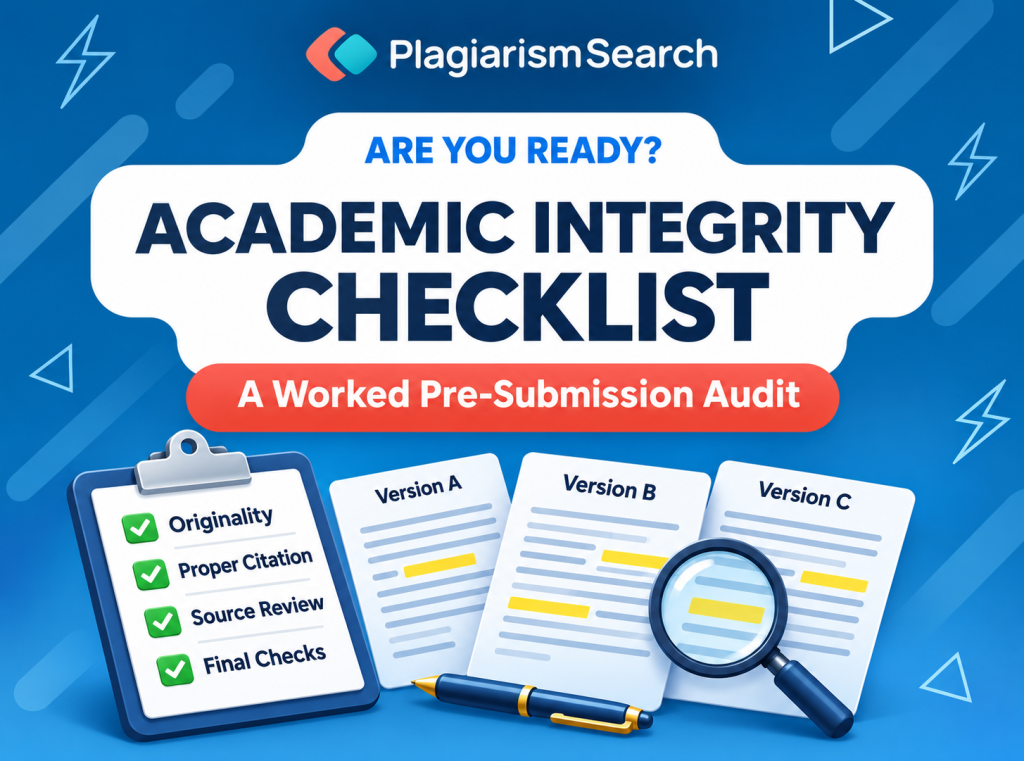
Academic integrity checklist before submission
Use this checklist after you have a complete draft, including its tables, references and any required declarations. For each item, record where you checked, what evidence you consulted and what action you took. A tick without evidence is not enough if you later need to explain a decision.
| What to check | Evidence to consult and action to take |
|---|---|
| Assignment requirements | Read the current task instructions and relevant institutional rules. Record permitted assistance, citation requirements and any restrictions. |
| Borrowed language and ideas | Compare source-dependent passages with the original. Mark exact language as quotation or write an independent paraphrase; credit borrowed ideas as well as words. |
| Citation and claim alignment | Open the cited source. Locate the passage, table or dataset supporting the specific claim. Check the date, population, scope and meaning of the measure. |
| Numbers, tables and figures | Recalculate important differences and check units, labels, direction and consistency between the evidence and your prose. |
| Authorship and AI assistance | Compare your actual writing process with the assignment rules. Complete any required disclosure; ask for guidance if the use was unclear or prohibited. |
| Collaboration and outside help | Check whether feedback, editing, translation, collaboration or third-party help was permitted. Record the assistance and disclose it if required. |
| Reuse of your own work | Check rules on resubmitting or adapting earlier coursework. Identify reused material and obtain permission or acknowledge it where required. |
| Unresolved issues and final version | Record questions you could not resolve. Check that corrections appear in the exact file you intend to submit, including references and declarations. |
Prioritize issues that affect the central argument or the rules of the assessment. A missing source for a key conclusion may matter more than several minor formatting inconsistencies. This is a checklist for written academic work, not an exhaustive list of all integrity issues. Your institution or assignment may require additional checks, such as research ethics, data handling or group-work documentation.
If you are still planning or drafting your paper, the guide to avoiding plagiarism covers earlier stages of source tracking and writing. The workflow below concentrates on auditing a finished draft.
A worked audit: the assignment and materials
Imagine that a campus committee has requested a short evidence-based note about U.S. energy production and consumption in 2024. The fictional instructor allows generative AI to suggest search questions, but not to write the analysis. The author must distinguish national statistics from the evidence needed for decisions about individual campus buildings.
All three manuscripts are synthetic teaching materials prepared with AI assistance. None is an actual student submission or research publication. The simulated writing record is fictional. The exercise was selected for educational illustration after exploratory checks; the versions and review criteria were fixed before this case was checked. It is not a representative evaluation of detector accuracy. PlagiarismSearch developed this resource using reports from its own similarity-checking service; it is not an independent product evaluation.
The manuscripts use simplified author–date citations with descriptive source locators, not a prescribed citation style. In your own work, follow the required style for quotation marks, block quotations, punctuation and locators.
Version A contains the initial problems. Version B revises quotation and paraphrasing only. Version C also revises source interpretation, evidence and the simulated disclosure. C2 is a separate report for the unchanged version C, not a fourth manuscript.
| Report | Reported words | Displayed “Plagiarism” indicator | Listed source URLs | In-text citation filter |
|---|---|---|---|---|
| A | 678 | 15.72% | 20 | Off |
| B | 687 | 10.25% | 17 | Off |
| C | 770 | 9.15% | 17 | Off |
| C2 | 770 | 7.78% | 17 | On |
Reports were generated on 27 November 2026. The PDFs show web search enabled, with academic database search, AI text search, personal storage search, Latin-character conversion and reference exclusion disabled. No whitelist is displayed. The PDFs do not independently establish the settings for organization storage or adding documents to storage. The source counts are URL entries, not counts of distinct original works.
The archived reports document these particular runs. A later check may return different results as web content and indexing change, including possible indexing of the published practice files.
Review 1: Fix quotation and paraphrasing
Start with paragraph-level comparisons. Report A, page 3, identifies matches in the first three numbered paragraphs. Open the corresponding primary sources rather than relying on the report color alone. Version B shows three different repairs.
P01 — Exact words without attribution
Unattributed verbatim reuse
Source to check
S1: renewable production discussion. Compare the EIA sentence about record production of biofuels, wind and solar.
Version A — problem (exact manuscript excerpt)
Biofuels, wind, and solar production each set records in 2024, contributing to record total renewable energy production in the United States.
Version B — corrected (exact manuscript excerpt)
EIA (2025a, renewable production discussion) reports that domestic production of three renewable categories reached new highs during 2024: fuels derived from biomass, wind energy and solar energy.
Why it matters: A reproduces the EIA sentence without student attribution; report A, p. 3, shows a red match linked to S1 (source 4, among other URLs). B independently reorganizes the relevant fact and gives credit. It retains the record output of the three categories, not the additional statement about the overall renewables record. Accept the revision for the relevant claim and attribution, not because the highlight disappears.
Report note: Report B, p. 3: no visible body highlight for P01.
P02 — A citation without quotation marks
Quotation and attribution
Source to check
S2: consumption discussion. Locate the sentence comparing the 2024 consumption total with the 2007 peak.
Version A — problem (exact manuscript excerpt)
Energy consumption in the United States totaled 94.2 quads in 2024, remaining below the peak of 99.0 quads set in 2007. (EIA, 2025b, consumption discussion).
Version B — corrected (exact manuscript excerpt)
“Energy consumption in the United States totaled 94.2 quads in 2024, remaining below the peak of 99.0 quads set in 2007.” (EIA, 2025b, consumption discussion).
Why it matters: The reference in A identifies the source but does not mark the exact words as a quotation. B retains the wording, adds quotation marks and keeps the locator. The yellow match remains with the citation filter off. In C2 it is recognized as a citation. A valid quotation does not need to be rewritten simply to remove a highlight.
Report note: Reports A and B, p. 3: yellow match; S2 is source 5 in A and source 6 in B. The exercise uses simplified citations.
P03 — A paraphrase that stays too close
Close paraphrase with citation
Source to check
S3: historical coal discussion. Compare the source’s sequence of earlier coal uses: household heating, railway and marine transport.
Version A — problem (exact manuscript excerpt)
Earlier uses of coal included several purposes that are no longer common, such as in stoves for household heating and in engines for trains and ships (EIA, 2025c, historical discussion).
Version B — corrected (exact manuscript excerpt)
Coal once served transport and domestic heating roles that are much less typical today; EIA (2025c, historical discussion) illustrates this transition with steam-powered rail and marine transport and coal-burning household stoves.
Why it matters: A credits the source but follows its phrasing and sequence of examples too closely. B recasts the explanation around coal’s former transport and domestic heating roles. The source meaning and credit remain. Evaluate the passage against the original; the absence of a highlight in B does not establish a universal paraphrasing threshold.
Report note: Report A, p. 3: yellow match linked to S3, source 9. Report B, p. 3: no visible body highlight for P03.
For additional practice, see the annotated examples of patchwriting and paraphrasing.
Review 2: Verify the evidence behind every important claim
Version B fixes the first three issues, yet it still contains incorrect or poorly supported claims. The report does not visibly highlight the body of P04–P06 in any of the four runs. That is precisely why evidence checking must extend beyond the matched passages.
| Location | Problem in A and B | Evidence and repair in C |
|---|---|---|
| P04 — Measure | Incorrectly describes 25% as solar's share of all U.S. energy production. | S1, renewable production discussion: 25% is the year-over-year growth of solar energy production. C states the correct measure and comparison period. |
| P05 — Citation relevance | Gives an accurate fossil fuel statistic but cites the DOE page on balancing electricity supply and demand. | S3, opening discussion: fossil fuels accounted for 82% of U.S. energy consumption in 2024. C cites S3 and distinguishes it from the operational guidance in S4. |
| P06 — Table interpretation | Says natural gas exceeded petroleum by 1.1 quads. | S2, consumption discussion: petroleum was 35.3 quads and natural gas 34.2. C corrects the direction of the difference. |
Check the meaning of a statistic before using it
P04 illustrates how a real number can become a false claim when its denominator or comparison changes. Growth from one year to another and a share of total production are different measures. Open the source, identify what was measured, and record both the unit and the period. Then check that the sentence in your own draft answers the same question.
Check that the cited source supports the claim
P05 illustrates a different failure. The statistic is supported by a real EIA article, but the cited DOE page concerns another topic. A working link and a credible institution are not sufficient evidence for a particular statement. When a source exists but does not support the sentence, locate appropriate evidence or remove or qualify the claim. Do not simply replace a reference with a plausible-looking title. The guide to verifying academic references addresses the related problem of checking whether a reference actually exists.
Recalculate the conclusion
| Selected U.S. primary energy consumption, 2024 | Quadrillion British thermal units |
|---|---|
| Petroleum | 35.3 |
| Natural gas | 34.2 |
| Petroleum minus natural gas | 1.1 |
The subtraction is straightforward, but the original prose reverses the direction. Check whether the units, sign and population match the table. These are national primary energy figures, not measurements of the campus's electricity supply.
Why percentages alone can be misleading
B and C contain different amounts of text: 687 and 770 reported words. As a mathematical illustration only, if a percentage were based on a fixed numerator and those word counts, scaling B’s displayed value would give 10.25 × 687 ÷ 770 ≈ 9.15%. This happens to equal C’s displayed value. It does not establish the actual scoring formula, the matched-word count or the cause of the change. Judge the factual corrections against the evidence, not the percentage.
Review 3: Check AI permission and disclosure
The assignment's fictional process record states that AI generated search questions and the analysis in P08. The instructor permits only the search questions. In A and B, P07 nevertheless declares that no generative AI was used.
There are two separate problems:
- P07: inaccurate disclosure. The declaration does not reflect the simulated writing process. C revises the declaration to describe the assistance and earlier unauthorized use.
- P08: unauthorized assistance under the fictional rule. C replaces the earlier analysis with a proposed plan based on building-level meter readings and operating schedules. The previous use still requires an instructor's decision.
The exercise does not establish that a real student independently wrote the revision. All manuscript versions were created with AI assistance for the teaching exercise. The simulated authorship record exists to illustrate how to assess permission and disclosure, not to demonstrate a particular AI detector's performance. AI text search was disabled in all four reports.
For your own paper, keep records of the assistance you actually used and consult the specific assignment rules. If a use was prohibited, rewriting the passage or adding a disclosure does not retroactively make it permitted. If assistance was permitted, check what form of acknowledgement the instructor requires. The guide to AI assistance and academic dishonesty explores how these decisions can vary between assessments.
Review 4: Interpret matches and use the citation filter
The control paragraph, P09, contains a correctly marked and attributed quotation from the DOE grid-planning page (S4). It remains unchanged throughout the exercise because the manual comparison finds no attribution problem to repair.
Compare reports C and C2. They contain the same manuscript and report 770 words each. The displayed indicator changes from 9.15% to 7.78% when the in-text citation filter is enabled, a difference of 1.37 percentage points. Both list the same 17 source URLs with unchanged individual source percentages. Those percentages must not be added together: different source URLs may match overlapping text.
The report observations show two useful distinctions. P02, the quotation repaired in B, remains yellow in C but appears green as a recognized citation in C2. P09 also appears green in C2, although it had no visible source-linked body match in A, B or C and the original DOE page is absent from the source list. Citation recognition is not proof that the checker has found the original source.
The filter changes how the report treats recognized quotations; it does not change the manuscript or make unacknowledged copying acceptable. Recognition may depend on formatting. Keep legitimate quotations where they serve the argument, and verify attribution against the original.
What the report shows versus what the reviewer finds
| Finding | A | B | C | C2 |
|---|---|---|---|---|
| P01 — Unattributed reuse | Red | None | None | None |
| P02 — Missing quotation marks in A | Yellow | Yellow | Yellow | Green |
| P03 — Close paraphrase in A | Yellow | None | None | None |
| P04 — Incorrect statistic in A/B | None | None | None | None |
| P05 — Irrelevant citation in A/B | None | None | None | None |
| P06 — Reversed comparison in A/B | None | None | None | None |
| P07 — Inaccurate disclosure in A/B | None | None | None | None |
| P08 — Unauthorized assistance in A/B (simulated) | None | None | None | None |
| P09 — Valid quotation (control) | None | None | None | Green |
Red and yellow describe observed highlight colors, not a verdict of misconduct or a known threshold. Green means citation recognition in these reports. None means no visible body highlight in that paragraph, not a finding of correctness. In this case the reviewer had to resolve P04–P07 against evidence and keep the P08 policy question open. See the case guide, pp. 2–3 for the full answer key.
There is no universal acceptable similarity score. A low indicator cannot establish correct facts, appropriate AI use or adequate citation. A higher indicator can include legitimate quotations. Use the report interpretation guide for more context on reviewing individual matches.
Record your final review
A completed review log should tell you what you checked, what you changed and what remains unresolved. Use the exact paragraph, table or page location, and retain the relevant source locator or report observation where applicable.
| Location | Evidence | Action | Status |
|---|---|---|---|
| P02 | S2, consumption discussion; C2 recognizes citation | Quotation marks and source credit retained | Corrected |
| P06 | S2, 35.3 vs 34.2 quads | Reverse the incorrect comparison | Corrected |
| P08 | Fictional assignment rule and assistance record | Passage replaced; prior use disclosed; seek decision | Needs instructor guidance |
| P09 | S4, Balancing section | Retain correctly attributed quotation | Verified |
Use Verified, Corrected, Unresolved, Needs instructor guidance or Not applicable (with a reason). The filled case log uses more detailed labels: “Repaired in B/C” and “Disclosure corrected in C” correspond to Corrected; “No repair needed” corresponds to Verified. P08 is “Text replaced in C; policy review open,” which still requires instructor guidance. A corrected finding means you have checked the revised evidence; it is not a certification of the whole document. If a policy question or material factual issue remains open, do not mark the paper as cleared for submission. Recheck the final file rather than an older draft.
Download the review toolkit
All practice manuscripts contain exercise labels; earlier versions intentionally contain errors. Do not cite them as energy research or treat the simulated declarations as real student records.
| Material | How to use it |
|---|---|
| Blank review log (TSV) | Apply the method to your own paper. |
| Filled review log (TSV) | Compare your findings with the eight problems and one control. |
| Case guide and answer key (PDF) | Review the simulated assignment, sources, findings and report limitations. |
| Manuscript A (TXT), B (TXT), C (TXT) | Compare the initial draft, attribution revision and evidence revision. |
| Report A (PDF), B (PDF), C (PDF), C2 (PDF) | Review actual results and compare the citation filter with identical C text. |
To use either TSV file, import it into Excel or Google Sheets using tab-separated columns and UTF-8 encoding. The blank template has eight columns, including Reviewer / date. The filled case log is an expanded ten-column example with separate observations for A, B, C and C2, rather than an identical filled copy of the blank template. Add rows as needed. Avoid including unnecessary personal or sensitive information when sharing a completed log.
The goal is not a perfect score or a completely unhighlighted report. It is a document whose claims, sources, quotations and declared writing process you can explain and support, with remaining questions made explicit.
How to use this case in an academic integrity workshop
Suggested 30-minute activity: distribute Manuscript A and the blank review log before sharing the answer key. For a short session, assign a subset of the findings to each group; allow more time if students review the entire manuscript and all four sources.
- Read and identify (5 minutes): identify a passage that requires checking and note the relevant assignment rule.
- Investigate (10 minutes): compare the passage with the primary source or simulated process record. Record a specific locator and a proposed correction.
- Compare and discuss (10 minutes): reveal the relevant sections of B/C, the answer key and the reports. Discuss why P02 remains matched with the filter off and why P04–P08 require evidence beyond highlighting.
- Reflect (5 minutes): explain why P09 needs no repair and why P08 still requires an instructor’s decision. Ask learners what they would check in their own work.
Assess whether learners identify the issue accurately, locate relevant evidence, justify the proposed action and distinguish corrected findings from unresolved questions. Do not grade the exercise by the lowest similarity percentage. This is a proposed teaching activity, not a validated assessment instrument.
Primary sources and methodology notes
- S1. U.S. Energy Information Administration (9 June 2025). In 2024, the United States produced more energy than ever before. Renewable production discussion.
- S2. U.S. Energy Information Administration (20 June 2025). U.S. primary energy production, consumption, and exports increased in 2024. Consumption discussion.
- S3. U.S. Energy Information Administration (2 July 2025). How has U.S. energy use changed since 1776?. Opening and historical discussions.
- S4. U.S. Department of Energy (n.d.). Solar Grid Planning and Operation Basics. Balancing section; accessed 27 November 2026.
Source material from EIA and DOE is credited in the exercise. The teaching author has intentionally adapted certain statements and introduced errors in earlier versions; those errors are not assertions by the agencies. No agency endorsement is implied. See the EIA reuse policy and DOE web policies before redistributing source material.