An academic reference can look convincing and still lead nowhere. It might contain a nonexistent study title, the wrong author, a DOI that belongs to another paper, or a real article that does not support the claim beside it. If an AI assistant suggests a citation, treat it as a lead to verify—not as evidence that the source exists. To check a reference, confirm four things independently: that the work exists, that its bibliographic details match, that its contents support the statement you want to make, and that it has not been corrected or retracted in a way that changes your interpretation. A missing DOI or search result is a reason to investigate, not proof that a publication was fabricated. A fabricated academic reference claims to identify a publication that was never actually published. Because proving nonexistence can be difficult, researchers often classify references as possibly fabricated or unverifiable using a stated search protocol rather than declaring every unsuccessful search definitive. A misleading entry may carry plausible authors, a credible journal name and even a DOI-shaped identifier while providing no traceable evidence. However, several different problems are often grouped together under the word “fake.” A miscited source exists, but its metadata—perhaps the date, author or title—is wrong. An unverifiable source cannot be resolved confidently after a stated search process; it may be nonexistent, but it may also be poorly indexed, translated, old or accessible only in a local archive. A misrepresented source is real, yet its evidence does not justify the accompanying claim. Finally, a retracted article exists but has an important change in publication status.What is a fake academic reference?
| Reference issue | What it means | Appropriate next check |
|---|---|---|
| Possibly fabricated | Claimed work is not found under a documented search protocol. | Broaden searches; request original evidence. |
| Unverifiable | Source identity remains unresolved, including possible indexing or archive gaps. | Check catalogs, alternate scripts and archival records. |
| Miscited | A real work has incorrect author, title, date or identifier details. | Correct fields against the original record. |
| Misrepresented | A real work does not support the attached statement. | Read the relevant passage and narrow the claim. |
| Status changed | A correction, retraction or version update affects how the work is used. | Review publisher notices and current version. |
Those distinctions matter. A spelling mistake calls for correction; a genuine study quoted inaccurately calls for a closer reading; a source that remains unverified should not be used to substantiate a claim until its provenance is established. Neither one invalid reference nor the use of an AI writing tool, by itself, proves intentional academic misconduct or plagiarism. Two recent investigations looked for problematic references in published scholarly work. They are useful evidence that bibliographies need checking, but they examined different bodies of literature using different definitions. Their results cannot be combined into a single worldwide rate of AI-generated false citations. Topaz and colleagues (2026) examined a stratified random sample of 500,000 peer-reviewed journal papers from chemistry, physics, materials science, engineering and computer science, published between January 2023 and March 31, 2026. Their full article reports 26.2 million extracted references, of which 21.6 million (about 82%) had a resolvable DOI and entered the same verification process. The pipeline flagged 1,135 citations across 619 papers as potentially fabricated. In masked review of 400 flagged candidates, two independent experts confirmed 85.8%. This is the study’s estimated precision among flagged candidates—not recall, which would measure how many problematic references in the entire literature were found. The study did not estimate recall. The remaining references without a resolvable DOI were not evaluated by the same process. Here, “fabricated” is an operational classification: the claimed title was not found in seven bibliographic or open-web sources under the authors’ procedure. The results describe the studied disciplines and DOI-bearing reference subset. They do not establish whether authors used AI, why errors occurred or the overall rate of all false references. See the original PNAS study, its PubMed record and the research-team university summary. Han and colleagues (2026) reviewed 3,201 peer-reviewed conference papers from selected venues, mainly in AI and education, published between 2023 and 2025. They found 69 papers—2.16% of that corpus—with at least one reference that remained unverifiable under their multi-stage procedure. That percentage describes flagged papers in those selected proceedings, not the percentage of individual references that were wrong and not the rate across all disciplines. The distribution varied substantially by venue: ICOCT 2025 alone accounted for 37 of the 69 flagged papers (53.6%). The authors expressly excluded inconclusive non-English and regionally indexed references from the reported unverifiable counts; incomplete indexing and transliteration can still limit verification. The apparent year-to-year increase is sensitive to conference composition, so it cannot be treated as a universal trend or evidence that generative AI caused the change. Read the original JASIST study.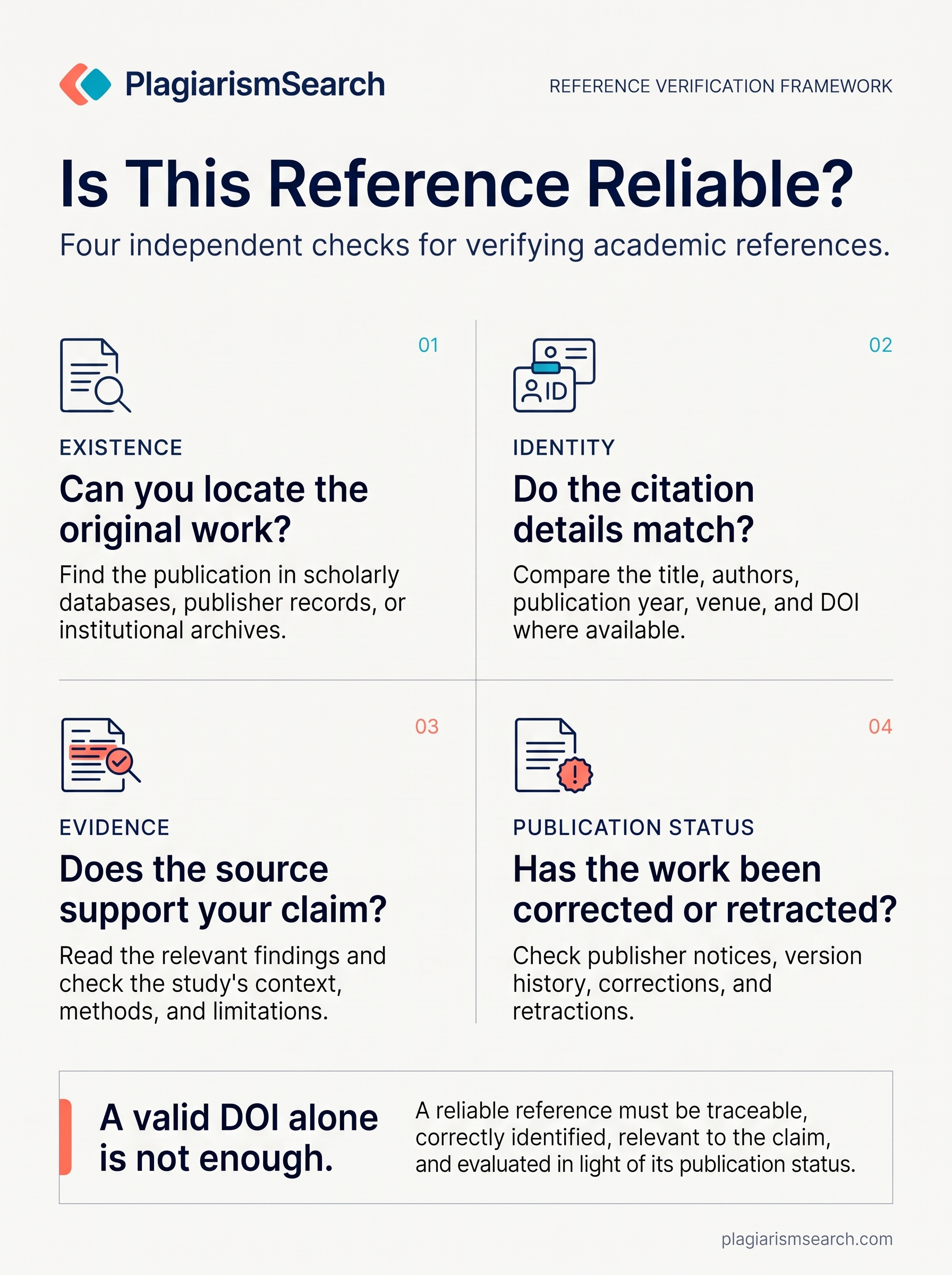
What research published in 2026 actually found
A PNAS study examined 500,000 published papers
A JASIST study audited 3,201 conference papers
| Study | Corpus and findings | Limits of interpretation |
|---|---|---|
| PNAS (2026) | 500,000 journal papers; 21.6 million DOI-bearing references screened; 1,135 potentially fabricated references across 619 papers. | 85.8% estimated precision in a review of 400 flagged candidates; recall not estimated. Selected scientific and technical disciplines only. |
| JASIST (2026) | 69 of 3,201 papers (2.16%) contained at least one unverifiable reference. | Selected conference proceedings; inconclusive cases excluded; counts refer to papers, not individual references. |
Interpretation: These findings describe different samples and verification protocols. Neither study establishes a universal fabrication rate or demonstrates that AI caused the observed reference problems. Together, these studies support a practical conclusion: a professional-looking bibliography is not enough. Reviewers, writers and readers need a traceable way to confirm a reference’s identity and the evidence it is supposed to provide. No single warning sign proves fabrication. Use these as reasons to perform a more specific check. The following workflow works whether a reference comes from a search engine, a colleague, a bibliography or an AI assistant. Keep a short record of the checks so another reader can repeat them. Copy the full citation exactly as supplied: title, authors, publication date, journal or publisher, volume or page details, DOI or URL, and any quoted passage. Beside it, write the specific sentence for which you intend to cite it. Do not quietly repair missing fields from memory or ask AI to invent a replacement. You are checking two claims: “this paper exists” and “this paper supports my statement.” If a DOI is given, open it through doi.org followed by the exact identifier. Search the same DOI through Crossref’s metadata search or consult its official REST API documentation. Compare the returned article title, creator names, venue and year with the proposed reference. If the DOI leads to a different genuine article, mark the original citation as a metadata mismatch. Do not assume that correcting the DOI makes the original claim true. Also remember that not every legitimate scholarly source has a DOI, and not every DOI is registered with Crossref; some are handled by DataCite or other registration agencies. Search the exact title in quotation marks, then try a shorter distinctive phrase combined with an author surname. Check the claimed journal or publisher directly. Broaden the search to OpenAlex, PubMed for relevant biomedical work, institutional repositories, library catalogs or subject archives. If you find a preprint and a later journal article, establish which version the citation describes. For non-English titles, try the original script and accepted transliterations. A missing record in one database should lead to another targeted search, not an accusation. Compare the candidate work against the supplied reference field by field: first author and coauthors, exact title, venue, year, volume or article number, and DOI when applicable. A mismatch can be a minor typo, a confused edition or a reference assembled from details belonging to different genuine works. If the paper exists but the citation fields are wrong, fix them from the publisher or archival record and note the correction. If you cannot establish which work the writer intended, leave the reference unresolved rather than selecting the closest-looking search result. Open the abstract and, when available, the relevant passage of the full paper. Find the specific data, comparison, quotation or conclusion your sentence depends on. Verify the study population, period, definitions and limitations, not just whether a keyword appears. For example, a paper may report that 69 of 3,201 selected conference papers had at least one unverifiable reference. That does not support the statement that 2.16% of all published scientific references were AI-generated. The paper is real; the extrapolation is not. If the abstract is insufficient to validate a precise claim, obtain the full text or withhold that claim. Inspect the publisher’s article page for notices and version history. Crossmark can reveal updates recorded by participating publishers, and Crossref provides access to Retraction Watch data. These tools help, but their coverage is not complete. No notice in one database is not a guarantee that the work has never been corrected. A retracted article may still be relevant when discussing the retraction itself. It should not be used as unqualified support for a finding that has been withdrawn. Use more than “valid” or “fake.” A practical review log should allow these outcomes: (a) source located and claim supported; (b) source exists but citation metadata need correction; (c) source exists but does not support the claim; (d) source cannot currently be located after documented checks; and (e) source has a correction, retraction or version change that requires review. Save the publisher URL or catalog record, the date checked, and one sentence explaining your decision. If the source cannot be verified, do not cite it as established evidence. Replace it with a genuinely reviewed source—or remove the unsupported statement. The following are original, fictional teaching scenarios, not reports of real academic misconduct. Any deliberately false title or author below is invented for instruction. Do not copy an exercise citation into a bibliography. Submitted exercise entry (fictional): “Researcher, A. (2026). Why All AI Citations Are False. Journal of Universal Evidence. https://doi.org/10.1073/pnas.2623869123.” What to check: Resolve the DOI and compare its title, authors and journal to that invented entry. The DOI actually identifies Topaz, Gupta, Zhang and Peltonen’s 2026 PNAS paper about possibly fabricated references in a sample of 500,000 papers. It does not identify the fictional Researcher article. Result: A genuine DOI has been attached to false bibliographic details. Action: Reject the exercise entry, locate the actual intended source and verify its evidence before writing a replacement citation. Merely seeing the DOI resolve would not have exposed the problem. Submitted claim (fictional and unsupported): “Han et al. (2026) proved that generative AI produced every phantom reference in academic conferences.” What to check: The real Han et al. paper examined selected conference proceedings and found that 69 of 3,201 papers included at least one reference classified as unverifiable after its verification protocol. Other references were labelled inconclusive and excluded from the reported counts. The authors discuss uneven venue distribution and do not establish a causal link to AI use. Result: The paper exists, but the statement is not supported. Action: Write a narrower sentence about the observed sample and refer to the original study. A fully accurate DOI and journal title cannot validate a misrepresented result. Submitted situation (entirely hypothetical): An editor receives a reference to an old regional education report, naming an institution, editor and year, but providing no DOI. Crossref has no result. What to check: Search the institution’s historical publications, national library catalog, archived collections, alternate spellings and original-language title. Request a scan or stable catalog entry. Without those records, the source is not yet verified—but it has not been shown to be invented. Result: Unresolved pending archival evidence. Action: Do not use it to support a factual claim until located; do not publicly accuse its alleged creator of fabrication solely because Crossref has no entry. First, check for small citation errors: a misplaced year, alternate title, missing middle initial or preprint published under a different name. Then ask whoever supplied the reference for the original file, a publisher link or a library catalog record. The more specific the claim, the more important it is to inspect the underlying text. If these checks fail, mark the source “not verified” in your notes. Choose a verified alternative that independently supports the same claim, or revise your writing to acknowledge the evidence gap. Do not turn uncertainty into a confident allegation that a named researcher invented a paper. The same discipline applies to AI-generated reference lists. An AI assistant can help suggest search terms, but a confident-looking title, fabricated DOI or polished summary is not itself evidence. Check original records and applicable academic or publisher rules. AI-assisted writing is not automatically plagiarism, although false attribution and unsupported claims can create serious integrity problems. Reference verification is distinct from reviewing text similarity. For help with checking source matches in context, see our guide to interpreting a similarity report. For broader guidance on acknowledging sources in your own writing, see how to avoid plagiarism. Before submitting or publishing a reference, ask: If any answer is uncertain, document the uncertainty and resolve it before treating the source as evidence. This is a verification task for writers and editors—not a numerical plagiarism score or an automated judgment about someone’s intent. Printable Reference Verification Checklist (PDF, A4, one page) Use one copy per reference to record the citation, the claim it is meant to support, the seven checks and your review outcome. The worksheet includes space for notes and useful verification resources. This article distinguishes source existence from metadata accuracy, evidential support and publication status. The two 2026 published-corpus studies cited above have different samples and verification protocols; their measurements are not pooled or treated as estimates for all academic literature. The three case studies are original teaching illustrations, not real incident reports. For reference checking, use publisher pages and scholarly registries rather than relying on AI output or search snippets alone.Seven warning signs worth investigating
How to verify an academic citation in seven steps
Step 1. Save the proposed reference and the claim it is meant to support
Step 2. Resolve the DOI and compare the resulting metadata
Step 3. Search for the actual work by title and author
Step 4. Verify the bibliographic identity
Step 5. Check the claim inside the source
Step 6. Check versions, corrections and retractions
Step 7. Record an evidence-based result
Three annotated examples
Example 1. A real DOI with an invented title
Example 2. A genuine study used to justify an invented conclusion
Example 3. An older non-DOI source that is not immediately searchable
What if you still cannot find the source?
Source-verification checklist for students and editors
Reference verification glossary
Sources and methodology