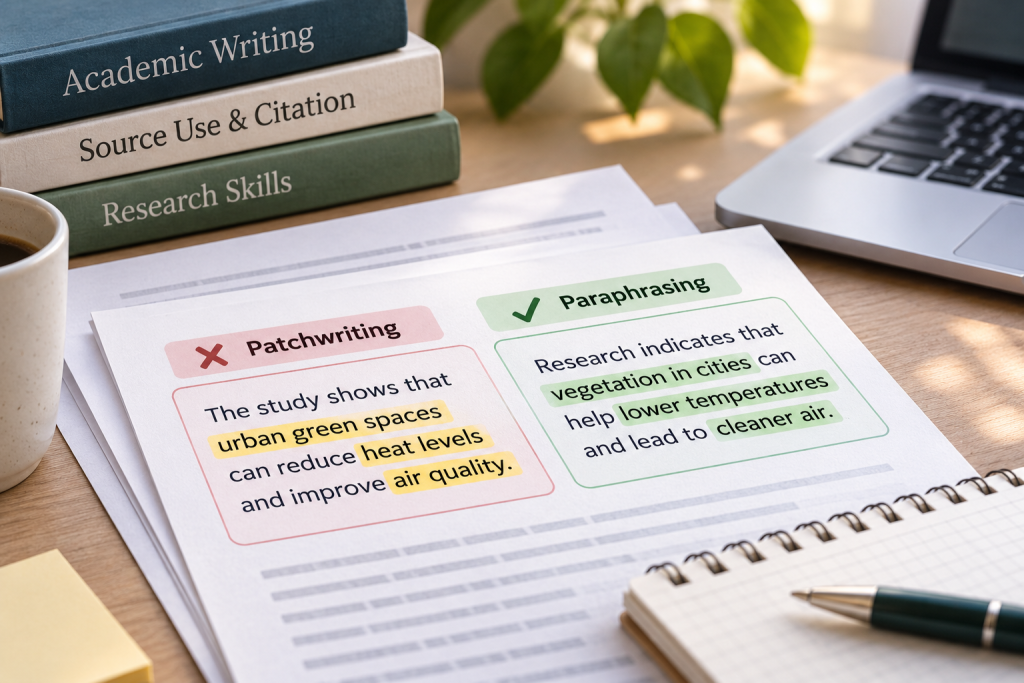
Patchwriting happens when a writer changes pieces of a source sentence but remains too dependent on its distinctive wording, structure, or progression. Paraphrasing involves understanding what the source says, re-expressing that meaning in independently formed prose, and giving the source appropriate credit. Replacing a few synonyms does not turn patchwriting into a responsible paraphrase; adding a citation does not automatically fix copied language either. [1] [2]
The distinction matters during learning. A close early draft may show that a writer is still making sense of unfamiliar material, not that the writer meant to deceive. Yet final source-based work generally requires more: accurate meaning, quotation marks when exact wording is retained, and citation for borrowed ideas. Course or publication rules determine how mistakes are handled. [2] [3]
Below are 12 entirely original, fictional teaching exercises. Nine examine wording, structure or quotation boundaries; three address related problems involving meaning, translation and synthesis. Not every error is patchwriting, and a similarity percentage is not a misconduct verdict.
Patchwriting, paraphrasing, and quotation: quick comparison
| Approach | What it looks like | Next step |
|---|---|---|
| Patchwriting | A sentence or paragraph keeps a source’s distinctive language or organization while replacing, dropping, reversing, or rearranging small parts. It may have a citation and still need substantial revision. [1] [2] | Explain the idea independently, compare accuracy with the source, and quote wording that must remain exact. |
| Faithful paraphrase | The writer preserves the source’s claim, relevant limits, and qualifications, but creates a new sentence structure and explanatory focus. The source still receives appropriate attribution. [4] [5] | Confirm the paraphrase does not invent observations or remove uncertainty. |
| Direct quotation | Exact language is intentionally preserved because its form matters. It is visibly marked as quoted and connected to the appropriate source and locator when the chosen citation style requires one. [4] | Check quotation accuracy and context. |
No fixed number of shared words or single similarity-score threshold separates these categories. Standard technical terms can remain unchanged if replacing them would distort a concept. Conversely, retaining an unusual metaphor or distinctive argument sequence may create an attribution problem even where most individual words differ.
How to read the 12 examples
Each numbered exercise has five parts: an invented source passage, a weak or misleading student version, a revised teaching version, an explanation of the exact problem, and a citation note. The weak examples are shown for diagnosis, not recommended writing. Every source passage is invented for this article. [Source A] through [Source L], including [Source E1/E2] and [Source L1/L2], are exercise labels only—not actual APA, MLA, or Chicago references, and not real institutional research.
The cases fall into three overlapping learning groups: close wording and quotation (01–06), structure and comprehension (08, 09, 11), and meaning and citation boundaries (07, 10, 12).
12 annotated examples
Case 01: Synonym swapping is not paraphrasing
Lexical patchwriting
Original source (fictional exercise)
At the fictional North Pier Library, reserve textbooks stay behind the service desk so students can borrow them for two hours during examination week.
Too close or inaccurate (for diagnosis only)
At the imaginary North Pier Library, reserved coursebooks remain behind the help counter so learners may loan them for 120 minutes during testing week.
Better version
During exam week, North Pier Library operates a staff-managed reserve service that provides two-hour textbook loans [Source A].
Why it matters: The weak text replaces fictional/imaginary, textbooks/coursebooks, service desk/help counter, and two hours/120 minutes in nearly identical positions. The underlying syntax stays intact. The improved version changes the informational center to the library’s loan service while retaining the exam-week context and two-hour limit. Word substitution was never the central task; explaining the service accurately was.
Citation note: Credit the actual library policy in a real assignment; [Source A] is only a teaching marker. Do not invent a school document.
Case 02: Switching to passive voice leaves the source skeleton
Grammatical patchwriting
Original source (fictional exercise)
Every Friday, volunteers collect paper that the ecology club has sorted into labeled bins during the week.
Too close or inaccurate (for diagnosis only)
Paper that has been sorted into marked bins by the ecology club during the week is collected every Friday by volunteers.
Better version
The imaginary ecology club sorts paper into labeled containers throughout the week, ready for volunteers to pick it up on Friday [Source B].
Why it matters: Changing “volunteers collect” into “is collected by volunteers” does not by itself create an independently framed explanation. The weak sentence follows the same participants, timing, and collection relationship in reverse voice. The revision instead follows the workflow—club sorting first, volunteer pickup second—without changing who performs each action. This is still source-based information and needs attribution.
Citation note: In authentic work, replace [Source B] with the real record used to describe the club process.
Case 03: Reversing two sentences is not a fresh explanation
Structural patchwriting
Original source (fictional exercise)
The neighborhood garden stores rainwater in closed barrels for watering seedlings during dry weeks. Signs remind visitors not to drink the stored water.
Too close or inaccurate (for diagnosis only)
Signs remind visitors not to drink stored water; seedlings are watered during dry weeks with rainwater kept in closed barrels at the neighborhood garden.
Better version
To keep seedlings watered during dry spells, the fictional neighborhood garden maintains a supply of rainwater in closed barrels. Visitors are reminded by posted notices that the stored water is not for drinking [Source C].
Why it matters: The weak text reorders two source sentences while retaining nearly all their language. It remains tied to the original construction. The revised text begins with the purpose of the water supply and distinguishes that purpose from the safety warning. It retains closed barrels rather than inferring how water is collected or whether the containers are airtight. Changing sentence order alone is not evidence of comprehension.
Citation note: Both source-based functions—watering and the do-not-drink warning—remain attributable to [Source C].
Case 04: A memorable phrase needs visible quotation
Exact-wording boundary (not just patchwriting)
Original source (fictional exercise)
The fictional museum guide describes its reading room as “a quiet harbor for unfinished questions” and asks visitors to hold conversations outside.
Too close or inaccurate (for diagnosis only)
The museum reading room is a quiet harbor for unfinished questions where people should speak outside [Source D].
Better version
The fictional guide calls the reading room “a quiet harbor for unfinished questions” and asks visitors to continue conversations outside [Source D].
Why it matters: The student’s weak version includes a source marker but hides the exact distinctive phrase inside ordinary prose. The better version visibly identifies the borrowed expression as a quotation and paraphrases only the remaining instruction. When the precise metaphor is irrelevant, an independent summary would also work. This exercise tests quotation treatment rather than a rule that every shared expression must be enclosed in quotation marks.
Citation note: The phrase is original teaching fiction; its quotation marks and [Source D] label model two separate functions. Real citations also need proper bibliographic details.
Case 05: A mosaic can hide two sources and reverse a condition
Multi-source patchwriting plus meaning distortion
Original source (fictional exercise)
Fictional Source E1: The school library stays open longer during examinations, but its extended hours end after final tests.
Fictional Source E2: A student club holds evening study sessions only when adult volunteers are available to supervise.
Too close or inaccurate (for diagnosis only)
The library keeps expanded hours after the final tests, and the student club hosts nighttime sessions with adults present [Source E1].
Better version
During the fictional school’s exams, the library temporarily extends opening hours, ending that schedule after the final tests [Source E1]. Separately, the student club can run evening sessions only when adult volunteers supervise [Source E2].
Why it matters: The weak draft draws on E1 and E2 but cites only E1. It also converts “end after final tests” into “keep expanded hours after final tests,” changing the library’s rule. The corrected version credits both sources, preserves the library’s end condition, and retains the supervision requirement. Combining two sources can be legitimate synthesis, but each contribution must be traceable and accurately described.
Citation note: E1 and E2 are independent fictional notes; a real paper needs two genuine source citations, not one catch-all marker.
Case 06: A citation does not repair a near-copy sentence
Cited patchwriting
Original source (fictional exercise)
Because the supply of loaned lab kits is limited, the fictional department requires reservations before Friday and returns within one day.
Too close or inaccurate (for diagnosis only)
Since the supply of borrowed laboratory kits is limited, the imaginary department demands bookings before Friday and returns within one day [Source F].
Better version
The fictional department restricts access to its scarce lab kits in two ways: students must reserve them before Friday and return each kit within one day [Source F].
Why it matters: The weak version preserves the source’s opening causal clause, sentence order, deadline, and closing expression. It merely changes “because” to “since,” “loaned” to “borrowed,” and “requires” to “demands.” Source credit is present, yet the borrowed sentence still looks nearly the same. The revised text makes the two operational constraints the organizing principle, while retaining both their deadlines.
Citation note: [Source F] demonstrates idea attribution, not permission to copy the source’s particular phrasing.
Case 07: Changing “may” into “will” invents an outcome
Meaning distortion—not automatically patchwriting
Original source (fictional exercise)
The fictional campus archive may open on Saturday if at least four volunteers confirm by Thursday; the coordinator has not yet made a final decision.
Too close or inaccurate (for diagnosis only)
The archive will open on Saturday because four volunteers have already signed up [Source G].
Better version
The fictional archive has not decided whether to open on Saturday. It could open only if at least four volunteers confirm by Thursday [Source G].
Why it matters: The weak text invents a completed sign-up and turns a conditional possibility into a certain event. Even a totally different sentence structure would not make that claim faithful. The better version preserves the unresolved decision, the minimum number of four and the Thursday deadline. This is mainly a paraphrase-accuracy error. It should not be scored as an automatic or intentional plagiarism verdict.
Citation note: Borrowed conditions are still attributed to the fictional [Source G]; real policy text would need a real citation.
Case 08: A good paraphrase can preserve terms without copying the structure
Positive comparison / faithful paraphrase
Original source (fictional exercise)
The fictional transport museum keeps duplicate maps in storage because its display cases cannot hold the entire collection.
Too close or inaccurate (for diagnosis only)
The imaginary transport museum stores extra maps because its display cabinets cannot accommodate the whole collection [Source H].
Better version
The fictional transport museum has more items than it can fit into its display cases. Duplicate maps therefore remain in storage [Source H].
Why it matters: The weak sentence exchanges fictional/imaginary, duplicate/extra, cases/cabinets and hold/accommodate while keeping the original explanatory layout. The revised text begins with the specific display-case capacity limitation and then explains what happens to the duplicate maps. It preserves the same cause and consequence and adds no unsupported visitor, cost or curation claims. A responsible paraphrase may still share ordinary terms such as “museum,” “maps,” and “storage.”
Citation note: A new structure does not erase the origin of a museum-specific fact. Source H remains acknowledged.
Case 09: An argument copied move by move is still too close
Rhetorical-structure patchwriting
Original source (fictional exercise)
At the fictional Harbor Study Center, weekday rooms are reserved for exams, so staff schedule online workshops on Saturdays. They record registration totals, but have not tested whether this format changes attendance.
Too close or inaccurate (for diagnosis only)
As weekday spaces are booked for tests, the imaginary center holds web workshops on Saturdays. It tracks sign-up numbers, although it has not checked whether the setup affects turnout [Source I].
Better version
The fictional study center counts workshop registrations but has not evaluated whether its Saturday online format affects attendance. Exam bookings make its rooms unavailable on weekdays, which is why the workshops are scheduled for Saturdays [Source I].
Why it matters: The weak version follows the source’s three moves in exactly the same order: weekday constraint, online Saturday choice, then an untested attendance effect. It changes individual words but not the argument’s progression. The stronger version foregrounds the untested outcome before explaining the scheduling decision. It does not claim improved attendance or pretend registration totals measure impact.
Citation note: The causal scheduling explanation and the lack of a tested outcome both belong to the invented [Source I].
Case 10: Translating an outside source does not change whose idea it is
Cross-language attribution—not necessarily patchwriting
Original source (fictional exercise)
Original Ukrainian teaching sentence: “У вигаданому музеї відвідувачі отримують навушники перед екскурсією, щоб не заважати іншим групам.”
Too close or inaccurate (for diagnosis only)
In a museum, visitors receive headphones before the tour so they do not disturb other groups.
Better version
To avoid disrupting other groups, the fictional museum hands out headphones to visitors before each tour [Source J, Ukrainian-language exercise].
Why it matters: The English sentence translates the original meaning closely, but without credit it hides that the information comes from another writer’s passage. Translation across languages does not transfer authorship of the underlying idea. The better version reorganizes the explanation and credits the Ukrainian exercise source. Translating your own text and translating a third party’s text are different cases; any assistance from translation or AI tools must also fit the assignment’s rules. [6]
Citation note: [Source J] is not a real Ukrainian publication. In authentic work cite the source and follow the style’s treatment of translated quotations.
Case 11: Keep technical terminology, not an author’s decorative metaphor
Technical terms versus source-specific imagery
Original source (fictional exercise)
At the fictional Digital Archive, staff store a checksum for each uploaded file. A later difference can suggest that its contents changed, but the comparison cannot identify an editor. A trainer calls the signal “a lantern in a locked drawer.”
Too close or inaccurate (for diagnosis only)
The archive stores a checksum for every uploaded file. Later differences can suggest its contents changed, but not identify the editor. The signal is a lantern in a locked drawer [Source K].
Better version
The fictional archive compares stored file checksums with later values to look for possible changes; this does not reveal who edited a file [Source K].
Why it matters: A checksum is an ordinary technical term; substituting an inaccurate synonym would make the explanation worse. The weak version, however, reproduces the source’s three-step progression and unusual metaphor almost intact. The better version preserves the technical function and its limitation but leaves out the nonessential image and changes the explanatory structure. Do not call the shared word “checksum” plagiarism; examine distinctive expression and source credit.
Citation note: [Source K] still credits the fictional technical explanation. If a real author’s metaphor is retained literally, quote and attribute it.
Case 12: Synthesis cannot manufacture causal improvements
Multi-source accuracy and attribution—not simply patchwriting
Original source (fictional exercise)
Fictional Source L1: The campus library offers early-morning research workshops for students unable to attend during the day.
Fictional Source L2: The campus writing center gives feedback by appointment but does not edit students’ assignments.
Too close or inaccurate (for diagnosis only)
The campus's early workshops and professional editing guarantee better grades [Source L1].
Better version
The fictional campus provides two distinct supports: early research workshops for students with daytime conflicts [Source L1] and appointment-based writing feedback that does not include editing students’ assignments [Source L2].
Why it matters: The weak text invents a guaranteed academic outcome, describes feedback as professional editing, and fails to identify L2. The revised version keeps each service’s purpose, the scheduling constraint and the writing center’s limitation. A source-based synthesis is not automatically more credible just because it connects two sources; the connection must not overstate what either source establishes. This case is about factual fidelity and traceable credit rather than surface-level synonym patchwriting.
Citation note: The two invented service descriptions are separate [Source L1] and [Source L2] records; real research needs genuine citations to both.
12-case diagnostic index
| Case | Diagnostic issue | Next step |
|---|---|---|
| 01 | Synonyms preserve sentence skeleton | Rebuild from the idea and credit the source |
| 02 | Voice change only | Reframe the process, keep who and when |
| 03 | Sentence reversal only | Organize around meaning, retain the warning |
| 04 | Distinctive phrase unquoted | Quote exact wording and cite |
| 05 | Two-source mosaic and time error | Restore scope and cite E1 and E2 |
| 06 | Cited but too close | Change information structure as well as vocabulary |
| 07 | May becomes will | Restore conditional status |
| 08 | Synonym copy versus faithful paraphrase | Preserve the cause, reframe and cite |
| 09 | Rhetorical moves mirrored | Reorganize the reason and evidence limitation |
| 10 | Translated third-party source uncredited | Credit the translated source |
| 11 | Nonessential metaphor copied | Retain the technical term, recast the explanation |
| 12 | Invented outcomes from two sources | Remove guarantees, cite L1 and L2 |
This is a teaching index, not a scored checklist or a plagiarism-detection benchmark.
Four checks before you submit a paraphrase
- Meaning: Does your version preserve every condition, quantity, timeframe, uncertainty, causal direction, and explicit limit? Look especially at the “may/will” trap in Case 07 and invented outcomes in Case 12.
- Wording and structure: Did you actually understand and reorganize the explanation, or did you just change vocabulary, switch active/passive voice, or reverse the order of sentences? Cases 01, 02, 03, 06, and 09 show different ways the original structure can remain visible.
- Attribution: Can readers see which concepts came from the source, where exact language was quoted, and which source supported each of several claims? Cases 04 and 05 distinguish quotation and multi-source credit. An in-text citation alone may not repair unmarked verbatim phrasing.
- Policy: Does your institution or publisher permit the chosen use of source text, translation, AI assistance, and shared work? Keep working notes, verify the original material, and ask for clarification instead of assuming every policy is identical. [2] [6]
For the wider writing process, see our guide to avoiding plagiarism.
When quotation is better—and when matching terms are not a problem
Quote language when the precise wording is what you will discuss. In Case 04, the original metaphor is worth retaining only with visible quotation and source credit. In Case 11, the standard technical noun “checksum” needs no artificial disguise: the problem lies in retaining a distinctive nontechnical metaphor and mirroring the same explanation. Exact overlap in common terms is not automatically copying someone’s distinctive prose.
Common knowledge depends on a reader’s expectations and discipline. For example, “the Earth orbits the Sun” generally does not need a research citation in an introductory discussion, but a particular classroom’s count of posters would still need its actual source. [7]
AI assistance is another boundary, not a thirteenth source-use category. An AI-produced paraphrase is not automatically plagiarism. However, using a tool where prohibited, concealing required disclosure, or failing to cite the human sources on which a passage relies can create different problems. [6]
For instructors: a four-question diagnostic rubric
Instead of guessing intention from a sentence, ask the learner what the source means and which parts of the draft depend on its words or structure. Assess four questions:
- Does the version accurately convey the source’s meaning?
- Is the distinctive phrasing and organization independently expressed?
- Are source and quotation attribution clear?
- What is the next revision step?
A close draft can be a teachable sign of incomplete source comprehension; institutional rules still govern final submissions and disciplinary decisions. [1] [2] [3]
Try asking students to identify the exact matched phrases in Case 06, the absent attribution in Case 05, the unsupported certainty in Case 07, and the separate technical term versus metaphor in Case 11. The goal is explainable revision, not a percentage cutoff or an unsupported claim that a detection tool will flag every instance.
Sources and teaching notes
Every source passage A–L and every weak/better comparison above was created as fictional educational content for this article. No scenario depicts a real school, a real survey, a published study, or a product-detection experiment. The following sources support the instructional distinction between patchwriting, paraphrasing, quotation and policy-specific academic integrity; their own examples were not reproduced.
- Roggenbuck, T., Slotterback, E., & Mickavicz, M. (2020, April 21). Distinguishing Paraphrasing from Patchwriting. MLA Style Center.
- Purdue Online Writing Lab. Handout: Comparing Policies (excerpt from Howard, 1995).
- Howard, R. M. (1992). A plagiarism pentimento. Journal of Teaching Writing, 11(2). ERIC bibliographic record; full-text copy (Citation Project).
- Purdue Online Writing Lab. Paraphrasing.
- George Mason University Writing Center. Paraphrasing.
- University of Melbourne. Advice for students regarding translation and editing tools.
- Purdue Online Writing Lab. Frequently Asked Questions Regarding Plagiarism.