
A document with an unmarked copied sentence, a document with an attributed quotation, and a document that paraphrases a source are not the same kind of writing. Their similarity reports may nevertheless look surprisingly alike. In our demonstration, several texts with different approaches to source use received a displayed score of 0%.
We checked five short teaching texts with PlagiarismSearch and selected six report examples from eight actual runs. Rather than setting a target percentage, we examined which passages were highlighted, which sources appeared, and what a reader could reasonably conclude from each report. The examples include a direct match, overlapping sources, a recognized quotation, and a close paraphrase that produced no displayed match.
A similarity report supplies evidence for review, not a verdict about plagiarism. The interface in these screenshots labels its overall indicator “Plagiarism.” We retain that label when reporting the observed numbers; it does not mean that the percentage represents proven misconduct.
How we tested the similarity reports
On 25 November 2026, we used the English PlagiarismSearch report interface to check five synthetic, AI-assisted teaching texts. They were prepared for this demonstration, not collected from students. One text was composed without intentional source reuse. The other four used the same teaching context and varied the treatment of a sentence from NASA's Earth facts page: verbatim copying, quotation with attribution, close paraphrasing, and a more independently worded paraphrase. The quotation and close paraphrase were checked more than once.
| Item | Recorded detail |
|---|---|
| Date and language | 25 November 2026; English |
| Inputs and runs | 5 distinct teaching texts; 8 reports; 6 selected examples |
| Length | 104–118 words, as displayed in the reports |
| Deliberately selected source | NASA, Facts About Earth, Magnetosphere section |
| Planned settings | Web search enabled; AI checking, academic and private storage search, adding to storage, reference exclusion and Latin-character normalization disabled; citation exclusion varied for the quotation runs. |
| Settings evidence | Citation exclusion ON confirmed for example 04 by the test operator; example 03 is the repeat requested with OFF. A complete settings export or screenshot was not retained for each run. |
Limits of this demonstration: the set is small, deliberately constructed and focused on one known source. We did not retain a complete settings record for every run. Results describe the actual displayed reports, not a fully controlled validation of the search algorithm. We did not estimate accuracy, false-positive rates, false-negative rates or performance across languages. The examples are not a comparison with other checkers.
In the screenshots, the submitted NASA reference uses an abbreviated title and “n.d.” We preserve that text exactly as submitted. The source page identifies its title as Facts About Earth and displays a last-updated date of December 5, 2025. These details matter when reviewing the citation itself.
All six examples at a glance
| Example | Words | Overall score | Observation |
|---|---|---|---|
| 01. A text without deliberate source reuse | 104 | 0% | No Sources detected; no highlighted matches. |
| 02. An exact passage copied without attribution | 104 | 22.12% | The NASA sentence is highlighted red; four sources are displayed. |
| 03. An attributed quotation without citation highlighting | 117 | 0% | No Sources detected; the quotation is not highlighted and the Citations tab is absent. |
| 04. The same quotation with citation exclusion enabled | 117 | 0% | The quotation is green and listed in Citations; the overall indicator remains 0%. |
| 05. Patchwriting with a source citation | 115 | 0% | No Sources detected; no highlighted matches. |
| 06. A more independently worded paraphrase | 118 | 0% | No Sources detected; no highlighted matches. |
Five examples display 0%, but the source-use decisions behind them are different. Read the highlighted text, source list and citation information before interpreting the percentage.
Six real similarity report examples
These are screenshots of completed checks, not simulated report designs. We cropped unnecessary surrounding space and masked internal report identifiers and upload times. The text, scores, source lists and highlighting are preserved. Select a screenshot to view it at full size.
Example 01: A text without deliberate source reuse
Observed result: 0% · 104 words
No Sources detected; no highlighted matches.
The library-exhibition passage was composed for the demonstration without intentionally copying a source. It received a zero score and no sources were displayed. This tells us about the output of that check, not about every possible source on the web.
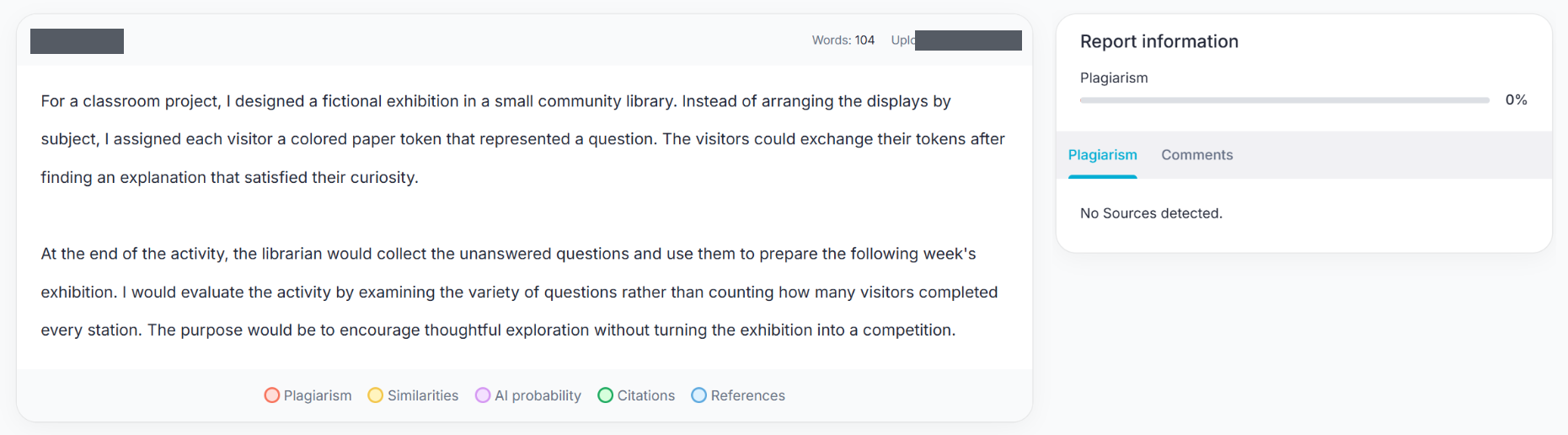
How to interpret this result: A reviewer should not treat this result as proof of originality or human authorship. The text was AI-assisted, and we did not run an AI-authorship analysis.
Example 02: An exact passage copied without attribution
Observed result: 22.12% · 104 words
The NASA sentence is highlighted red; four sources are displayed.
We inserted the original NASA sentence into a fictional classroom-exhibition text without quotation marks or attribution. The report highlighted the entire deliberately copied passage and included the intended NASA page among the sources. Other sites also appeared in the source list.
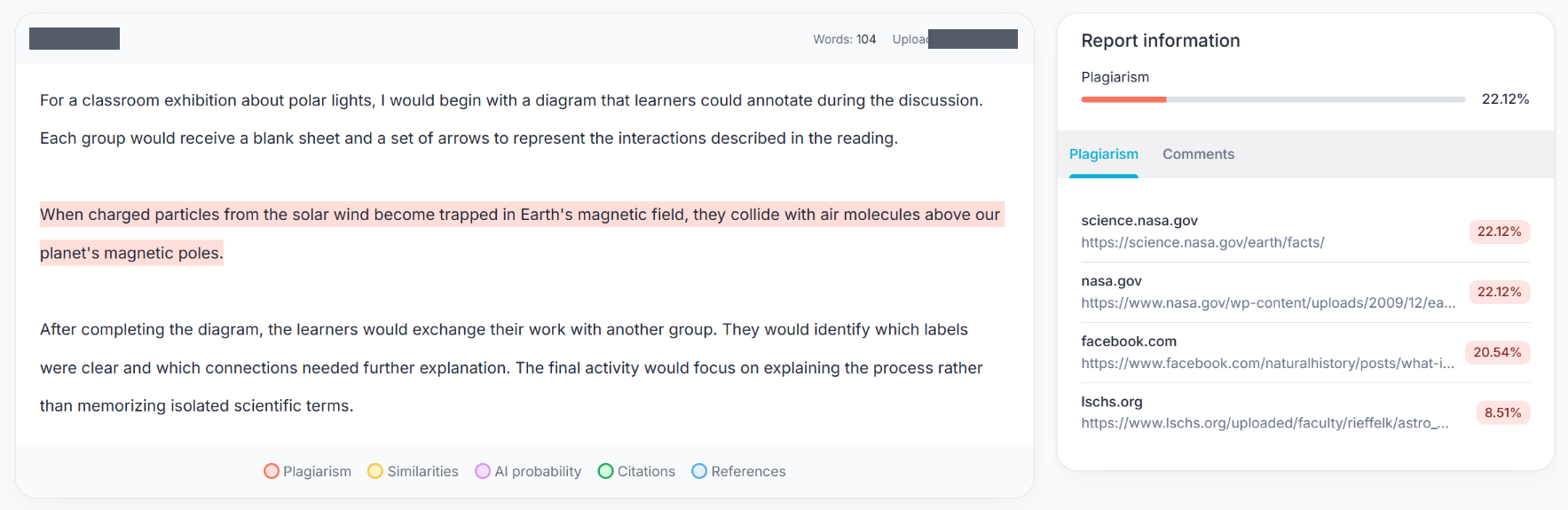
How to interpret this result: The known source and highlighted wording allow a reviewer to establish that the passage was copied in this exercise. That conclusion comes from comparing the texts and knowing the test design, not from the number or highlight alone. In actual student work, the circumstances and applicable rules still matter.
Example 03: An attributed quotation without citation highlighting
Observed result: 0% · 117 words
No Sources detected; the quotation is not highlighted and the Citations tab is absent.
The same source sentence was placed in straight double quotation marks, followed by an in-text attribution and a reference entry. In the repeat requested with citation exclusion disabled, the report displayed 0% and no sources. The quoted wording remained visible but was not highlighted.
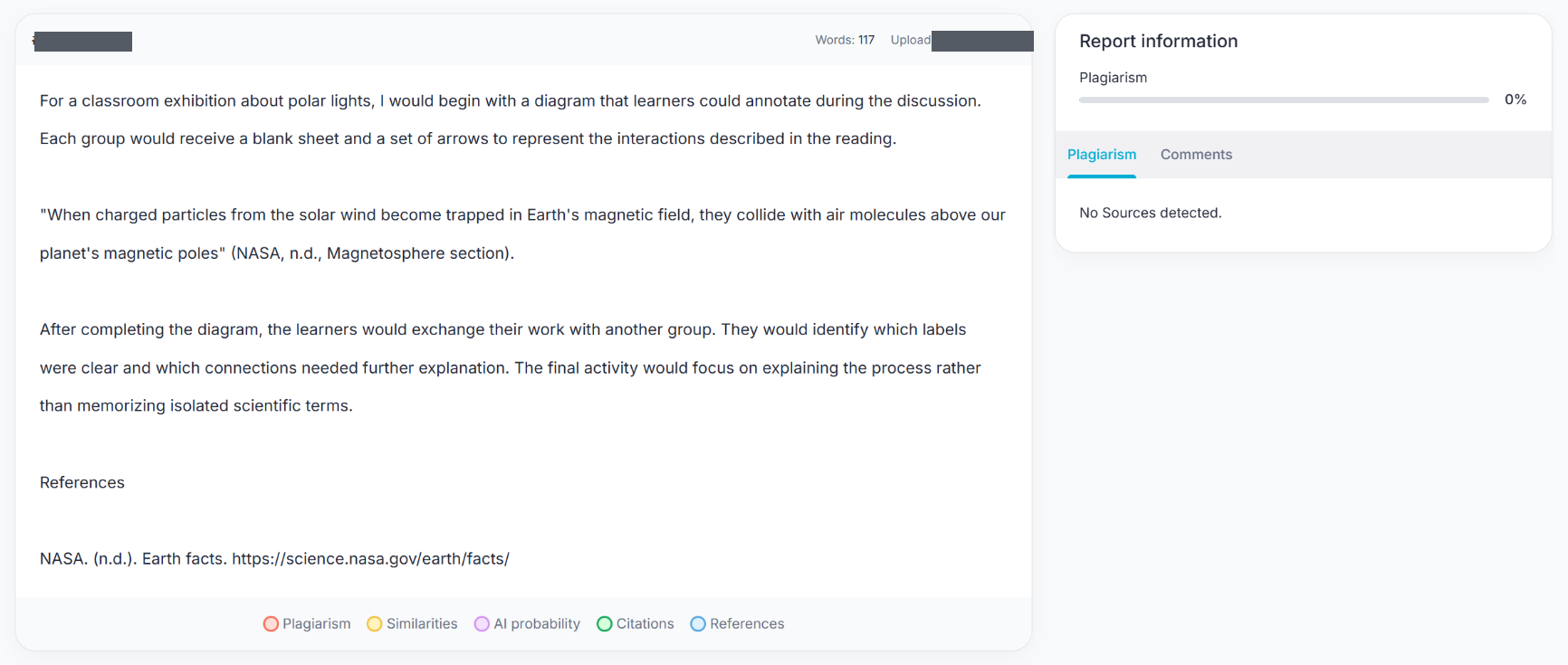
How to interpret this result: The report does not explain why the exact passage was not listed as a source match in this run. We cannot infer that the checker automatically accepted the citation or that disabling the setting always has this effect. The reviewer can still compare the quote with NASA and assess its attribution independently.
Example 04: The same quotation with citation exclusion enabled
Observed result: 0% · 117 words
The quotation is green and listed in Citations; the overall indicator remains 0%.
The operator confirmed that Exclude in-text citations was enabled for this run. The same visible text was checked and the quoted sentence appeared in green. The Citations panel lists the quoted text, while the Plagiarism panel showed no sources.
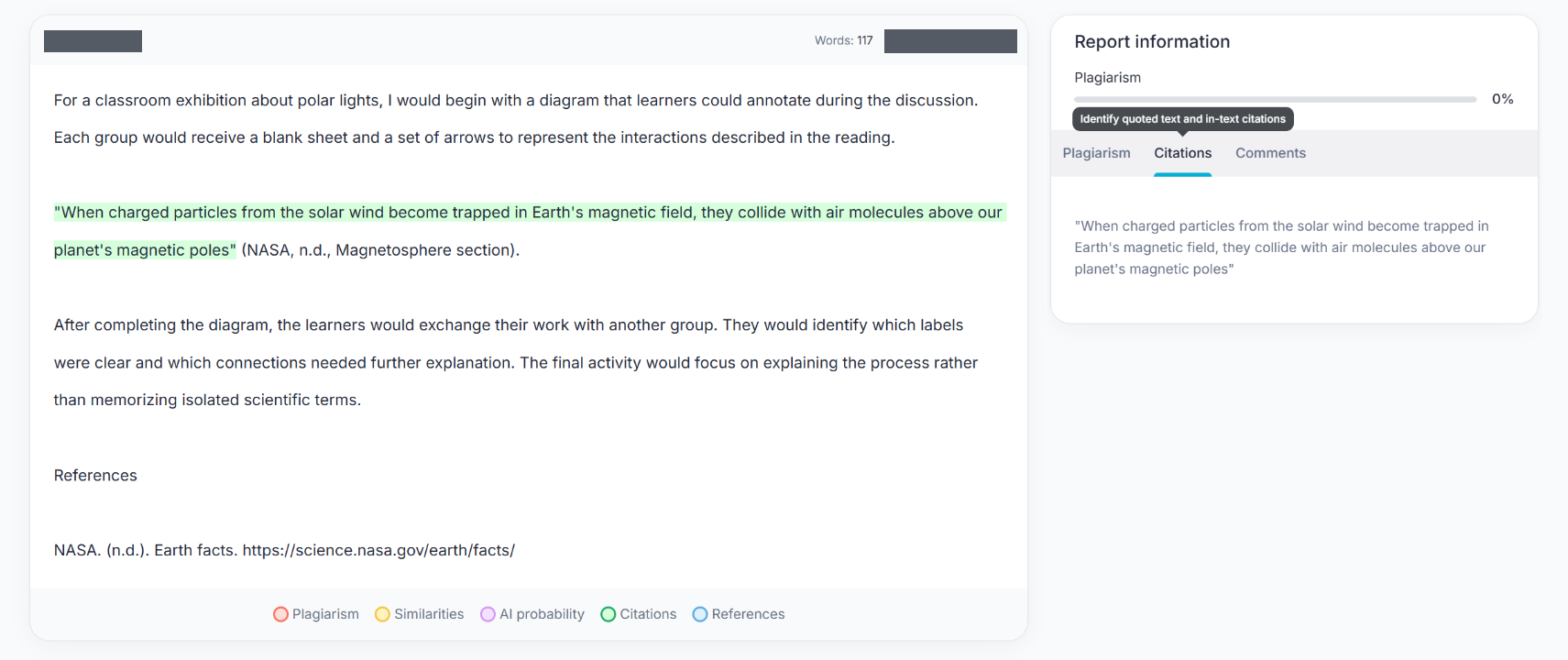
How to interpret this result: The quotation was recognized in this report. We did not observe a change in the overall percentage between examples 03 and 04. Green highlighting is not proof that an author name, date, reference entry, or quotation locator is correct. The bibliographic correction noted above is a practical illustration of that distinction.
Example 05: Patchwriting with a source citation
Observed result: 0% · 115 words
No Sources detected; no highlighted matches.
This version deliberately retained the source sentence’s order and replaced a handful of expressions. It included a NASA attribution and reference entry. The selected report showed 0%; a second run of the same close paraphrase also showed 0%. In the latter, the Citations tab was present but listed no detected citations.
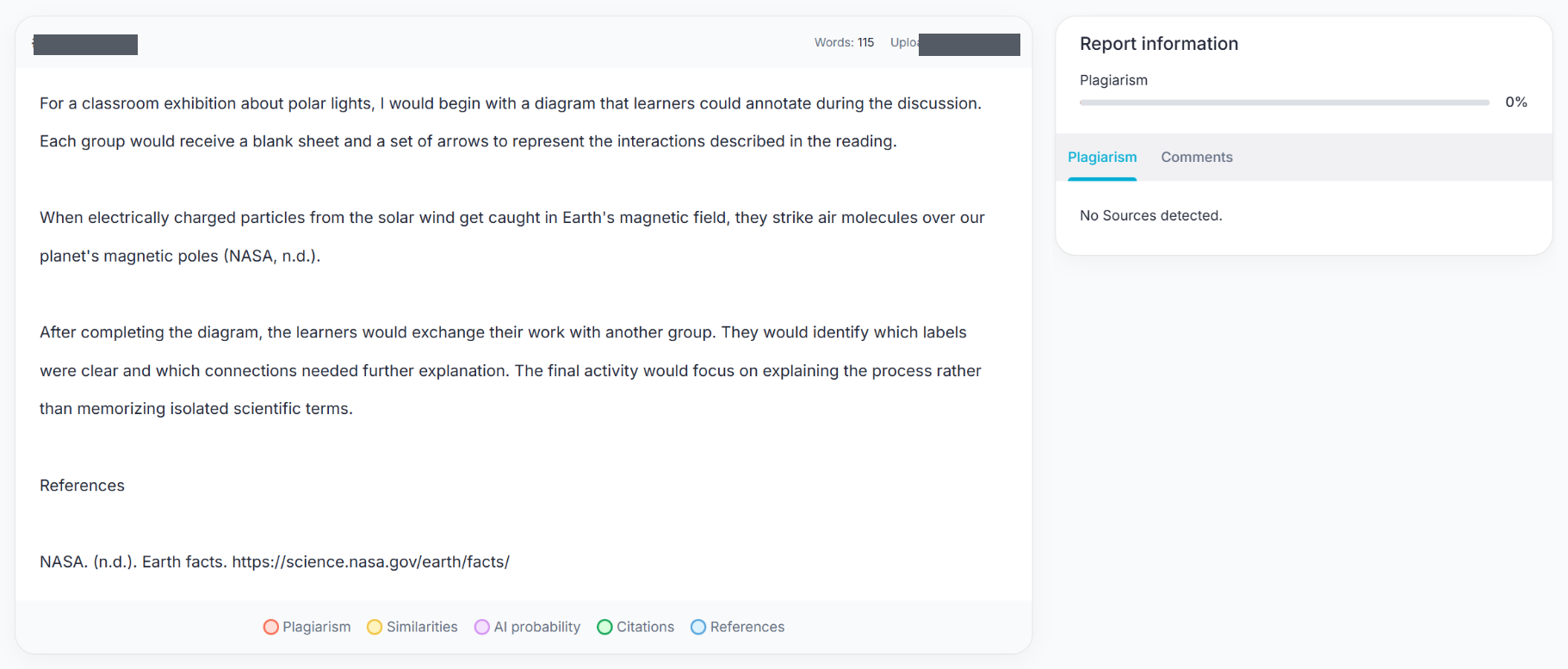
How to interpret this result: Small substitutions can leave a writer dependent on a source’s wording and sentence construction. The absence of displayed matches does not resolve that writing problem. A human comparison with the source remains necessary, even when an attribution is present.
Example 06: A more independently worded paraphrase
Observed result: 0% · 118 words
No Sources detected; no highlighted matches.
This version reorganized the source idea into two sentences, starting with the magnetic field’s role and then describing the interaction in polar regions. It retained NASA attribution and a reference entry. The report again showed 0%.
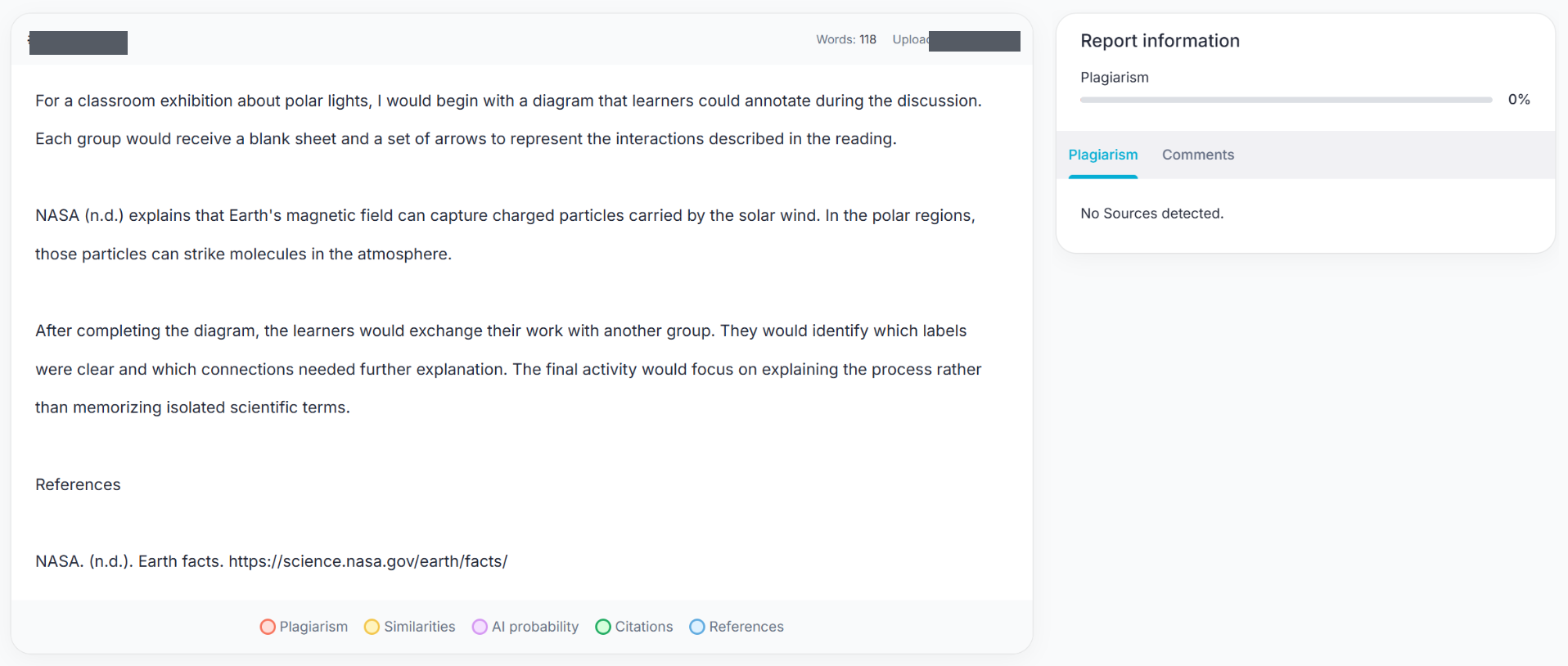
How to interpret this result: The wording and structure are more independent than example 05, but the score is identical. Review the explanation against the source for accuracy and use the citation format required for the assignment. The score is not what makes this a stronger paraphrase.
Why individual source percentages should not be added together
Example 02 illustrates a common mistake: treating the percentages beside individual sources as separate portions of the document. The same passage can be available on multiple websites. In this report, the two NASA entries alone each display the full overall percentage.
| Listed domain | Displayed source percentage |
|---|---|
| science.nasa.gov | 22.12% |
| nasa.gov | 22.12% |
| facebook.com | 20.54% |
| lschs.org | 8.51% |
Arithmetic sum of the four source percentages: 73.29%.
Actual overall percentage: 22.12%.
These numbers are not interchangeable. Multiple listed sources can correspond to overlapping text.
The deliberately copied sentence contains 23 words by a simple space-separated count. Dividing 23 by the report's displayed count of 104 words and multiplying by 100 gives approximately 22.12%. This agrees with the observed result after rounding, but does not establish a general score formula or the algorithm's treatment of all other texts and settings.
When reviewing a report, inspect the passages associated with individual sources and compare their wording. The source list is evidence to investigate, not a set of independent percentages to total. The earliest or highest-ranked entry is not necessarily the original publication.
Same similarity score, different writing quality
The last two reports are especially useful for teaching. A source attribution is present in both, but the writing process differs. Compare the submitted sentences, not just the numerical result.
Original source: NASA, Magnetosphere section
When charged particles from the solar wind become trapped in Earth's magnetic field, they collide with air molecules above our planet's magnetic poles.
Example 05 — close paraphrase (0%)
When electrically charged particles from the solar wind get caught in Earth's magnetic field, they strike air molecules over our planet's magnetic poles (NASA, n.d.).
Example 06 — more independently worded paraphrase (0%)
NASA (n.d.) explains that Earth's magnetic field can capture charged particles carried by the solar wind. In the polar regions, those particles can strike molecules in the atmosphere.
The editorial highlighting in the comparison above identifies selected substitutions; it is not detector output. The close paraphrase follows the source's sentence structure, replacing “become trapped,” “collide with” and “above” with similar expressions. The second version changes the explanatory focus and divides the information into two sentences. Necessary scientific terms can remain unchanged.
The MLA Style Center teaching resource on patchwriting emphasizes comprehension and distinguishes paraphrasing from small alterations to borrowed language. For further practice, see our 12 annotated examples of patchwriting and paraphrasing.
A practical question for an instructor is not “Which text has the lower percentage?” but “Can the writer explain the source accurately and independently, and identify where the information came from?” A similarity report can help start that conversation. It cannot substitute for reading the writing.
A practical checklist for reviewing similarity reports
Use the report as a starting point for revision or feedback. A score should never replace the review of the passages that produced it.
- Open and inspect the matched sources.
- Read highlighted passages in their surrounding context.
- Check quotations and attribution against the original source.
- Do not add overlapping source percentages together.
- Review the active search settings and exclusions.
- Evaluate paraphrasing independently of the score.
- Apply the institution’s academic integrity requirements.
For guidance on the report interface itself, see our guide to interpreting the PlagiarismSearch similarity report. The University of Leeds also advises reviewers of Turnitin reports to examine the full report rather than use its percentage as a measure of plagiarism; that educational principle is relevant here, not its product-specific mechanics.
For students, the goal is to improve source-based writing before submission. For educators, it is to use the evidence to give useful feedback and make fair, contextual judgments. A low percentage can coexist with a writing problem, and a highlighted passage may be a legitimate quotation. Neither number nor color tells the whole story.
Sources and methodology notes
Screenshots of all eight reports are documented in our internal test record. The six principal examples above include the requested repeat of the quotation with exclusion OFF and the operator-confirmed ON run. An earlier quotation run with undocumented filter state and a second close-paraphrase run also displayed 0%; they are retained as additional observations, not counted as independent input texts. The difference between the displayed direct-copy and quotation results is not explained by the available evidence.
These observations relate to the tested inputs and report interface on the stated date. Search coverage, settings and report behavior may vary. No claim is made that the tested cases establish universal recognition of quotations or paraphrases, or that any particular similarity threshold defines acceptable writing.
- NASA. Facts About Earth. Magnetosphere section; page last updated December 5, 2025. Original source for the deliberately reused sentence.
- Roggenbuck, T., Slotterback, E., & Mickavicz, M. Distinguishing Paraphrasing from Patchwriting. MLA Style Center. Teaching resource.
- University of Leeds. Interpreting Similarity Reports from Turnitin – Staff Guide. Cited for general educational interpretation, not for PlagiarismSearch scoring.
- PlagiarismSearch. First-party demonstration reports, November 25, 2026. Screenshots reproduced with internal identifiers and upload times masked.